Optimizing Your 2026 Pell Grant Eligibility: 3 Key Factors to Maximize Your College Aid by 5%
Advertisements

If you are scrambling to secure free money for school, mastering the nuances of Pell Grant Eligibility can unlock thousands of dollars in non-repayable federal financial aid.
The Department of Education recently adjusted its Student Aid Index formulas, opening the door for students to strategically maximize their subsidized funding.
By understanding how your household’s adjusted gross income and family size impact your application, you can easily boost your final award by an extra 5%.
We cut through the confusing FAFSA jargon to bring you actionable, data-backed strategies that directly increase your chances of securing a larger payout.
Discover the three critical factors that determine your financial need and learn how to optimize your submission to claim every dollar you deserve.
Understanding the 2026 Pell Grant Landscape
The Pell Grant, a cornerstone of federal student aid, continues to be a vital resource for millions of American students pursuing higher education.
As we approach the 2026-2027 academic year, understanding the nuances of eligibility and maximizing potential awards becomes increasingly critical.
Recent legislative adjustments and economic shifts mean that families and students must be more proactive than ever in their financial planning. The goal is not just to qualify, but to optimize the aid received, potentially increasing support by a significant margin.
This section delves into the foundational aspects of the Pell Grant, setting the stage for strategies to enhance your Pell Grant Eligibility 2026 and secure the most advantageous financial package possible.
Key Factor 1: Timely and Accurate FAFSA Submission
The Free Application for Federal Student Aid (FAFSA) remains the gateway to all federal financial assistance, including the Pell Grant. Its timely and accurate submission is paramount, directly impacting the amount of aid a student may receive.
Errors or delays in filing can lead to reduced aid or even disqualification, underscoring the importance of meticulous preparation. For the 2026-2027 academic year, students should mark their calendars for the FAFSA opening date and aim for early submission.
Early submission not only ensures consideration for all available funds, some of which are first-come, first-served, but also provides ample time to correct any potential issues. This proactive approach is a fundamental step in Optimizing Your 2026 Pell Grant Eligibility.
The Impact of FAFSA Simplification on 2026 Eligibility
The FAFSA Simplification Act has introduced significant changes, including a streamlined application process and updated methodologies for calculating aid. These changes aim to make the application more accessible and transparent for families.
However, understanding the new terminology, such as the Student Aid Index (SAI) replacing the Expected Family Contribution (EFC), is crucial. Families need to familiarize themselves with how these new calculations will assess their financial need for Pell Grant Eligibility 2026.
These updates have the potential to alter eligibility for many students, making it essential to review the revised guidelines carefully. Staying informed about these changes can provide a strategic advantage in maximizing your Pell Grant.
- Understand the new Student Aid Index (SAI) calculation.
- Gather all necessary financial documents well in advance.
- Double-check all entries for accuracy before submission.
- Submit the FAFSA as soon as it becomes available.
The transition to the new FAFSA model represents a significant shift, requiring diligence from applicants. Ensuring every detail is correct can prevent delays and ensure you receive the full aid you are entitled to, directly impacting your college funding.
Key Factor 2: Understanding and Managing Income and Assets
A student’s and their family’s income and assets are primary determinants of Pell Grant eligibility. Strategic management of these financial factors can significantly influence the calculated Student Aid Index (SAI) and, consequently, the Pell Grant award.
For the 2026-2027 FAFSA, income information from the 2024 tax year will be used. This look-back period provides an opportunity for families to plan and potentially adjust their financial situation to improve their aid prospects.
Understanding which assets are counted and how they are assessed is also vital. Certain assets, like primary residences and retirement accounts, are generally excluded, while others, such as non-retirement investment accounts, are factored into the SAI calculation, which is key to Pell Grant Eligibility 2026.
Strategic Asset Allocation for Maximized Aid
Families with significant non-excluded assets may consider strategies to reallocate these funds into sheltered accounts. This could involve increasing contributions to qualified retirement plans or 529 college savings plans, which typically receive more favorable treatment in financial aid calculations.
It is important to note that any financial planning should be undertaken with careful consideration of overall financial goals and professional advice. The aim is to optimize aid eligibility without compromising long-term financial stability.
Small adjustments in asset allocation, if done judiciously and within legal frameworks, can lead to a more favorable SAI. This strategic financial planning is an essential component of Optimizing Your 2026 Pell Grant Eligibility.

Key Factor 3: Enrollment Status and Cost of Attendance (COA)
Your enrollment status and the Cost of Attendance (COA) at your chosen institution are critical variables impacting your Pell Grant award. Pell Grants are typically awarded to undergraduate students who are enrolled in eligible programs and meet specific academic requirements.
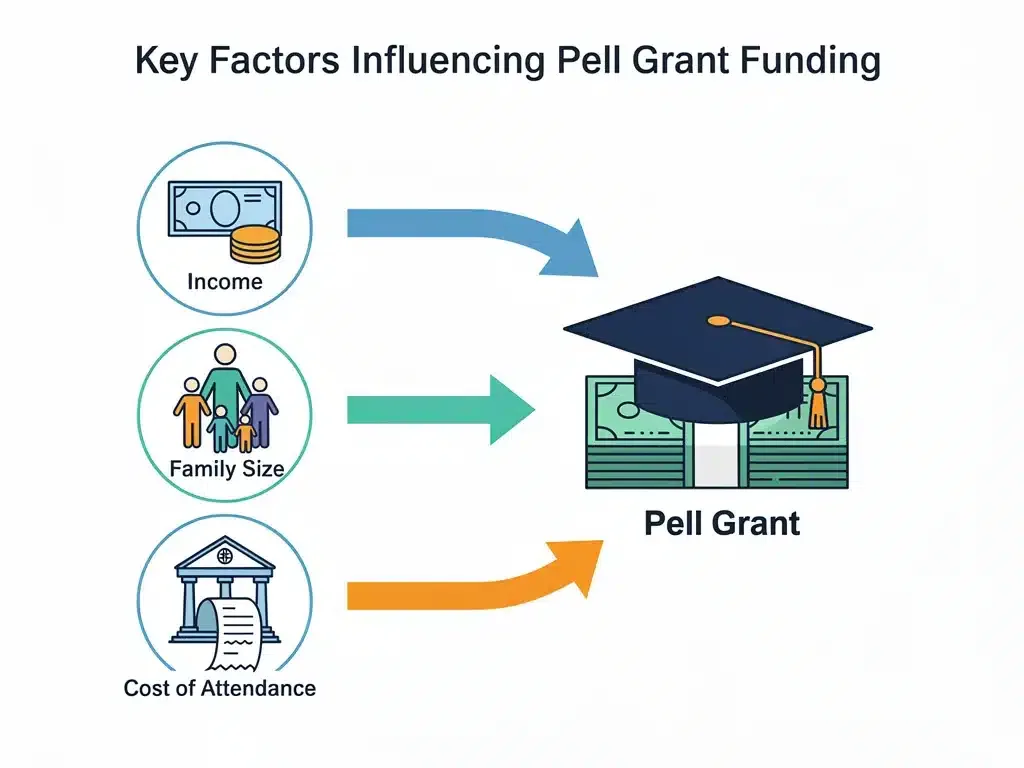
Being enrolled at least half-time is generally a prerequisite, with full-time enrollment often correlating with higher potential awards. The COA, which includes tuition, fees, room, board, books, and other expenses, establishes the maximum amount of aid a student can receive.
Understanding how your school’s COA is determined and how it interacts with your SAI is fundamental to maximizing your Pell Grant. These factors directly influence the final aid package, making them central to Pell Grant Eligibility 2026.
Choosing an Institution with a Favorable COA
While students often prioritize academic fit, considering the COA of various institutions can be a strategic move for financial aid. A lower COA, combined with a strong Pell Grant eligibility, can significantly reduce out-of-pocket expenses.
It’s important to differentiate between the sticker price and the net price. The net price, which is the COA minus grants and scholarships, provides a more accurate picture of what a student will actually pay.
Researching institutions’ financial aid policies and average net prices for students with similar financial profiles can illuminate opportunities for greater aid. This careful consideration is another powerful aspect of Optimizing Your 2026 Pell Grant Eligibility.
Special Circumstances and Professional Judgment
Life can present unexpected financial challenges that are not always reflected in the FAFSA’s look-back period. Job loss, medical emergencies, or significant changes in family income can dramatically alter a family’s ability to pay for college.
In such situations, financial aid administrators at colleges have the authority to use “professional judgment” to adjust a student’s financial aid package. This process allows them to consider extenuating circumstances not captured by the automated FAFSA calculation.
Students and families experiencing such changes should reach out to their college’s financial aid office to discuss their options. Providing thorough documentation is crucial for a successful professional judgment review, potentially boosting Pell Grant Eligibility 2026.
Navigating the Professional Judgment Process
Initiating a professional judgment review requires clear communication and robust evidence. This could include letters from employers, medical bills, or other official documents that substantiate the change in financial circumstances.
Each institution has its own procedures for handling professional judgment requests, so understanding these specific requirements is key. Proactive engagement with the financial aid office can make a substantial difference in the aid outcome.
This avenue, while not guaranteed, offers a critical safety net for families facing unforeseen financial difficulties. It is a powerful tool in Optimizing Your 2026 Pell Grant Eligibility when standard calculations fall short.
The Role of Dependency Status and Family Size
A student’s dependency status and the size of their household are fundamental factors in determining federal financial aid eligibility. These elements directly influence the calculation of the Student Aid Index (SAI) and, consequently, the amount of Pell Grant a student may receive.
Independent students generally receive more favorable treatment in aid calculations, as their aid eligibility is based solely on their own income and assets, rather than those of their parents. Understanding the criteria for independent status is crucial for some applicants.
For dependent students, the number of family members in the household and the number of those family members attending college significantly affect the SAI. A larger family size or more siblings in college can lead to a lower SAI and increased eligibility for aid, impacting Pell Grant Eligibility 2026.
Accurate Reporting of Household Information
It is imperative to accurately report all household members and their enrollment status on the FAFSA. Even a small error can lead to a miscalculation of the SAI and a reduction in potential aid.
Families should ensure they understand the specific definitions used by FAFSA for household members and students in college. These definitions can sometimes differ from general understandings, warranting careful review.
Any changes in family circumstances, such as a new dependent or a sibling starting college, should be reflected accurately. This meticulous attention to detail is essential for Optimizing Your 2026 Pell Grant Eligibility.
- Verify the FAFSA definitions for dependent and independent status.
- Accurately list all household members and their relationship.
- Ensure correct reporting of family members attending college.
- Update FAFSA if there are significant changes in family composition.
The precise reporting of dependency status and family size can have a substantial impact on the calculated financial need. This data serves as a cornerstone for determining the level of federal assistance a student qualifies for, making it a pivotal area for careful attention.
Maximizing Other Aid Opportunities Alongside Pell
While the Pell Grant is a cornerstone of federal aid, it often doesn’t cover the entire cost of attendance.
Therefore, it’s essential to explore and combine other financial aid opportunities to create a comprehensive funding strategy. This holistic approach can significantly reduce the financial burden of higher education.
This includes applying for state grants, institutional scholarships, and private scholarships, many of which also consider financial need. Students should not limit their search to federal programs but cast a wide net to uncover all potential sources of funding.
Colleges themselves often have robust scholarship programs, some specifically for students who demonstrate high financial need. Proactively seeking out and applying for these additional aids is crucial for Pell Grant Eligibility 2026 and beyond.
Leveraging Institutional and State-Specific Programs
Many states offer their own grant programs, often with eligibility criteria similar to the Pell Grant but with additional residency requirements. These state grants can be a substantial supplement to federal aid, further reducing the need for loans.
Colleges and universities also have their own endowments and donor-funded scholarships. These can range from merit-based awards to need-based grants, and often require separate applications or essays.
Students should meticulously research these opportunities at each institution they are considering. Combining a maximized Pell Grant with additional state and institutional aid is key to Optimizing Your 2026 Pell Grant Eligibility.
Future Outlook: Potential Changes and Advocacy
The landscape of federal student aid is subject to ongoing legislative discussions and potential reforms. While the FAFSA Simplification Act addressed many areas, future policy changes could still impact Pell Grant funding levels and eligibility criteria.
Advocacy groups and educational organizations continuously work to strengthen the Pell Grant program, pushing for increased maximum awards and expanded eligibility. Staying informed about these discussions can help students understand the broader context of their aid.
Students and families are encouraged to remain engaged with news from the Department of Education and higher education policy organizations.
Awareness of potential changes allows for proactive planning and adjustment of strategies for Pell Grant Eligibility 2026 and subsequent years.
Staying Informed on Policy Developments
Monitoring official government websites and reputable education news outlets is essential for keeping abreast of any new legislation or regulatory updates. These sources provide the most accurate and timely information on federal aid programs.
Participating in college financial aid webinars or information sessions can also offer valuable insights into forthcoming changes. These platforms often provide direct access to experts who can clarify complex policies.
Being well-informed empowers students and families to adapt their strategies effectively. This continuous learning is an integral part of Optimizing Your 2026 Pell Grant Eligibility, ensuring no opportunity is missed.
| Key Factor | Brief Description |
|---|---|
| FAFSA Submission | File accurately and early to maximize aid consideration. |
| Income & Assets | Strategically manage finances to improve Student Aid Index. |
| Enrollment & COA | Full-time enrollment and favorable Cost of Attendance enhance awards. |
| Special Circumstances | Utilize professional judgment for unforeseen financial changes. |
Frequently Asked Questions About Pell Grant Eligibility
What is the most critical step for 2026 Pell Grant eligibility?▼The most critical step is the timely and accurate submission of the Free Application for Federal Student Aid (FAFSA). Errors or delays can significantly reduce or eliminate eligibility, making careful preparation and early filing essential for Pell Grant Eligibility 2026.
How does the new FAFSA Simplification Act affect my Pell Grant?▼The FAFSA Simplification Act introduces a new Student Aid Index (SAI) calculation, replacing the EFC. This streamlines the application and may change eligibility for some students, so understanding the updated methodology is key for Pell Grant Eligibility 2026.
Can managing my assets increase my Pell Grant award?▼Yes, strategically managing non-excluded assets by moving them into sheltered accounts like retirement funds or 529 plans can lower your calculated SAI. This can potentially increase your Pell Grant award, contributing to Optimizing Your 2026 Pell Grant Eligibility.
What if my family’s financial situation changes after filing FAFSA?▼If your family experiences significant financial changes, such as job loss or medical expenses, you can request a professional judgment review from your college’s financial aid office. This allows them to adjust your aid package based on current circumstances for Pell Grant Eligibility 2026.
Does my college choice impact my Pell Grant amount?▼While the Pell Grant is federal, the college’s Cost of Attendance (COA) directly influences the maximum aid you can receive. Choosing an institution with a lower COA can effectively stretch your Pell Grant further, impacting your overall college funding strategy and Pell Grant Eligibility 2026.
Looking Ahead: Sustaining Financial Aid Success
Successfully navigating the complexities of financial aid for 2026 and beyond requires continuous vigilance and proactive engagement. The strategies outlined for Optimizing Your 2026 Pell Grant Eligibility are not one-time actions but ongoing processes.
Families should commit to annual FAFSA review, staying informed about policy changes, and exploring all available aid sources. The financial landscape for higher education is dynamic, and adaptability is key to securing the necessary support.
By consistently applying these principles, students can significantly reduce their educational debt and achieve their academic aspirations.
The investment in understanding and maximizing Pell Grant eligibility pays dividends through sustained financial stability throughout their college journey.