2026 Medicaid vs. Marketplace: Better Coverage for Your Family?
Advertisements

Latest developments on 2026 Medicaid vs Marketplace, with key facts, verified sources and what readers need to monitor next in Estados Unidos, presented clearly in Inglês (Estados Unidos) (en-US).
Comparing 2026 Medicaid Expansion Benefits vs. Marketplace Subsidies: Which Option Offers Better Coverage for Your Family? (COMPARISON/ANALYSIS, FINANCIAL IMPACT) is shaping today’s agenda with new details released by officials and industry sources. This update prioritizes what changed, why it matters and what to watch next, in a straightforward news format.
Understanding the Landscape of 2026 Healthcare Options
As 2026 approaches, families across the United States face critical decisions regarding their healthcare coverage. The choices often boil down to two primary avenues: Medicaid expansion benefits or subsidies available through the Health Insurance Marketplace.
Navigating these options requires a clear understanding of eligibility requirements, covered services, and the financial implications for households. This comparison aims to provide a factual and objective analysis to assist in making informed choices for family health.
The distinction between these programs is not merely semantic; it directly impacts access to care and out-of-pocket expenses for millions. Understanding the nuances of 2026 Medicaid vs Marketplace is paramount for securing adequate and affordable health insurance.
Eligibility Criteria: Who Qualifies for Each Program?
Eligibility is the first and most crucial factor in determining which healthcare option is available to a family. Medicaid expansion predominantly serves low-income individuals and families, with specific income thresholds varying by state.
The Affordable Care Act (ACA) expanded Medicaid to cover adults with incomes up to 138% of the Federal Poverty Level (FPL) in participating states. Families must meet these state-specific income guidelines to qualify for Medicaid benefits.
Conversely, Marketplace subsidies, officially known as Premium Tax Credits and Cost-Sharing Reductions, are designed for individuals and families with incomes generally above Medicaid thresholds but below 400% of the FPL. These subsidies help reduce the cost of premiums and out-of-pocket expenses for plans purchased through state or federal Marketplaces.
Medicaid Expansion Income Thresholds
For 2026, the specific FPL percentages for Medicaid eligibility will be updated, reflecting inflation and economic changes. Families should consult their state’s Medicaid agency for the most accurate and current figures.
States that have expanded Medicaid offer a broader safety net for working-class families and individuals who might not otherwise afford health insurance. This expansion has significantly reduced the uninsured rate in these participating states.
It’s important to remember that not all states have expanded Medicaid, which creates a coverage gap in non-expansion states. In these areas, some low-income adults may not qualify for either Medicaid or Marketplace subsidies.
Marketplace Subsidy Income Guidelines
Premium Tax Credits are available on a sliding scale, meaning those with lower incomes receive larger subsidies. Cost-Sharing Reductions further lower deductibles, co-payments, and out-of-pocket maximums for eligible individuals.
The availability of these subsidies makes Marketplace plans significantly more affordable for many middle-income families. The American Rescue Plan Act (ARPA) and Inflation Reduction Act (IRA) enhanced these subsidies, making them more generous and accessible through 2025; future legislative action will determine their status for 2026 and beyond.
Individuals and families enrolling through the Marketplace must also ensure they are not eligible for other affordable coverage, such as employer-sponsored plans or Medicare. This ensures that subsidies are targeted effectively.
Coverage Details: What Services Are Included?
The scope of services covered under Medicaid expansion and Marketplace plans differs, impacting the comprehensiveness of care families receive. Medicaid typically offers a very broad range of benefits, often including services not always covered by commercial plans.
Medicaid benefits usually encompass doctor visits, hospital stays, prescription drugs, mental health services, and preventive care. Pediatric services, including dental and vision, are particularly robust under Medicaid’s Early and Periodic Screening, Diagnostic, and Treatment (EPSDT) benefit for children.
Marketplace plans, while comprehensive, adhere to the ten essential health benefits mandated by the ACA. These include ambulatory patient services, emergency services, hospitalization, maternity and newborn care, mental health and substance use disorder services, prescription drugs, rehabilitative and habilitative services and devices, laboratory services, preventive and wellness services and chronic disease management, and pediatric services, including oral and vision care.
Medicaid’s Comprehensive Benefit Package
One of Medicaid’s key strengths is its extensive coverage, often with minimal to no out-of-pocket costs for enrollees. This can be a significant advantage for families with chronic conditions or high healthcare utilization.
Many states also offer additional benefits under Medicaid, such as non-emergency medical transportation and durable medical equipment, which can greatly reduce financial burdens. The focus is on providing a full spectrum of care to improve health outcomes for low-income populations.
The predictability of costs under Medicaid is another major draw for families seeking stability in their healthcare expenses. This stability allows families to budget more effectively without the fear of unexpected medical bills.
Marketplace Plans and Essential Health Benefits
Marketplace plans are categorized into metal tiers (Bronze, Silver, Gold, Platinum), reflecting the percentage of costs the plan covers versus what the enrollee pays. Higher metal tiers typically have higher premiums but lower out-of-pocket costs when care is received.
The availability of Cost-Sharing Reductions (CSRs) for those with incomes up to 250% of the FPL is particularly important. CSRs enhance Silver plans, making them more generous than standard Silver plans by reducing deductibles, co-pays, and out-of-pocket maximums.
Families choosing a Marketplace plan can select from various options, allowing for a degree of customization based on their specific healthcare needs and financial preferences. This flexibility is a key difference when comparing 2026 Medicaid vs Marketplace.
Financial Impact: Costs and Savings for Families
The financial implications of choosing between 2026 Medicaid vs Marketplace are substantial and can significantly affect a family’s budget. Understanding these cost structures is crucial for making an economically sound decision.
Medicaid, for most enrollees, comes with virtually no premiums, deductibles, or co-payments, making it an extremely low-cost option. This can translate into significant savings for families struggling to make ends meet.
Marketplace plans, even with subsidies, typically involve some level of premium payment, deductibles, co-payments, and co-insurance. However, subsidies can drastically reduce these costs, making plans affordable for many.
Out-of-Pocket Expenses Under Medicaid
For most Medicaid recipients, healthcare is essentially free at the point of service. This eliminates financial barriers to accessing necessary medical care, which is a core principle of the program.
Some states may impose nominal co-payments for certain services, but these are generally very low and often waived for vulnerable populations or specific services. The aim is to ensure financial hardship does not prevent access to care.
This absence of significant out-of-pocket costs can be a lifeline for families facing severe financial constraints, allowing them to prioritize other essential needs. The financial relief offered by Medicaid is a considerable benefit.
Marketplace Subsidies and Cost-Sharing
Premium Tax Credits can cover a substantial portion of monthly premiums, sometimes reducing them to very low amounts or even zero for certain income levels. The exact subsidy amount depends on income, family size, and local healthcare costs.
Cost-Sharing Reductions are a game-changer for those eligible, as they effectively make a Silver plan function like a Gold or Platinum plan in terms of out-of-pocket costs, but with the Silver plan’s lower premium. This is a crucial factor for families with moderate incomes.
Families must weigh the monthly premium costs against potential out-of-pocket expenses for care. A higher premium plan might offer lower deductibles and co-pays, leading to lower overall costs if significant medical care is anticipated. This careful consideration is part of the 2026 Medicaid vs Marketplace decision.

Provider Networks: Access to Doctors and Hospitals
Access to healthcare providers is another critical aspect when comparing 2026 Medicaid vs Marketplace options. Both programs have their own networks of doctors, specialists, and hospitals, which can vary significantly.
Medicaid managed care plans, prevalent in many states, operate with specific provider networks. While these networks are generally robust, some specialists or hospitals might not accept Medicaid, leading to potential access issues in certain areas.
Marketplace plans also utilize provider networks, which can differ widely between different insurance companies and plans. Consumers must verify that their preferred doctors and hospitals are in-network before enrolling in a Marketplace plan.
Medicaid Provider Access Considerations
Medicaid recipients generally access care through health maintenance organizations (HMOs) or preferred provider organizations (PPOs) that contract with state Medicaid agencies. These networks are designed to provide comprehensive care within certain geographical boundaries.
It is advisable for families considering Medicaid to confirm that their current healthcare providers accept Medicaid. While efforts are made to ensure adequate access, some regions may experience shortages of providers willing to accept Medicaid patients.
Despite these potential challenges, Medicaid remains a vital source of care for millions, with ongoing efforts to expand provider participation and improve access. The overall goal is to ensure that beneficiaries receive timely and appropriate medical attention.
Marketplace Plan Network Diversity
The Marketplace offers a variety of plans from different insurers, each with its own network. This allows for more choice in terms of network size and type, from broad PPOs to more restrictive HMOs.
Families can use the Marketplace website to search for plans that include their preferred doctors and hospitals. This is a crucial step to avoid unexpected out-of-network costs and ensure continuity of care.
The ability to choose a plan with a network that suits a family’s needs is a distinct advantage of the Marketplace. However, this also places the onus on the consumer to thoroughly research network adequacy before enrollment when considering 2026 Medicaid vs Marketplace.
Enrollment Periods and Application Processes
The timing and method of enrollment differ significantly between Medicaid and Marketplace plans. Understanding these processes is essential for families to secure coverage without gaps.
Medicaid enrollment is generally open year-round, meaning eligible individuals and families can apply at any time. Once approved, coverage typically begins retroactively to the first day of the month of application or even earlier in some cases.
Marketplace enrollment primarily occurs during the annual Open Enrollment Period, usually in the fall for coverage beginning the following year. Special Enrollment Periods (SEPs) are available for qualifying life events outside of Open Enrollment.
Medicaid’s Continuous Enrollment
The continuous nature of Medicaid enrollment ensures that eligible individuals can access care whenever their circumstances change. This flexibility is crucial for families whose income or household composition fluctuates.
The application process for Medicaid typically involves submitting an application to the state Medicaid agency, often through an online portal, mail, or in-person. Required documentation usually includes proof of income, residency, and household size.
States also have processes for redetermining eligibility periodically, usually annually, to ensure that beneficiaries continue to meet the program requirements. This helps maintain the integrity of the Medicaid program.
Marketplace Open and Special Enrollment
The Open Enrollment Period is the primary time for most people to enroll in or change Marketplace plans. Missing this window without a qualifying life event means an individual cannot get coverage through the Marketplace until the next Open Enrollment.
Qualifying life events for an SEP include marriage, birth of a child, loss of other health coverage, or a permanent move. These events trigger a limited window (usually 60 days) to enroll in a new plan.
The Marketplace website (HealthCare.gov or state-specific exchanges) provides a streamlined application process, allowing individuals to compare plans and apply for subsidies simultaneously. This integrated approach simplifies the process of securing coverage when making decisions about 2026 Medicaid vs Marketplace.
Addressing the Coverage Gap in Non-Expansion States
A significant challenge in the national healthcare landscape is the coverage gap that exists in states that have not expanded Medicaid. This gap affects millions of low-income adults who earn too much for Medicaid but too little for Marketplace subsidies.
In these states, individuals falling into this income bracket are left without affordable health insurance options. They are not eligible for traditional Medicaid because their state has not adopted the ACA’s expansion, and they do not qualify for Marketplace premium tax credits because their income is below the FPL.
This situation highlights a critical disparity in access to healthcare based on geographic location. Families residing in non-expansion states face unique hurdles when evaluating 2026 Medicaid vs Marketplace options.
Impact on Low-Income Families
Families in the coverage gap often forgo necessary medical care, leading to worse health outcomes and increased financial instability if they face a medical emergency. This disproportionately affects minority communities and rural populations.
The lack of preventive care can lead to more serious and costly health issues down the line, placing a greater burden on emergency rooms and charity care systems. This creates a cycle of poor health and economic hardship.
Advocacy groups continue to push for Medicaid expansion in all states, citing the positive impact on health, economic stability, and state budgets. The ongoing debate about 2026 Medicaid vs Marketplace is deeply intertwined with this issue.
Navigating Limited Options
For those in non-expansion states, options are severely limited. Some may rely on community health centers, free clinics, or employer-sponsored coverage if available. However, these are often insufficient for comprehensive health needs.
It is crucial for individuals in these states to be aware of their specific state’s policies and any local programs that might offer some form of assistance. State and local health departments can sometimes provide guidance on limited resources.
The political landscape surrounding Medicaid expansion continues to evolve, and families should stay informed about any legislative changes that could affect their access to coverage. This is a dynamic aspect of the 2026 Medicaid vs Marketplace discussion.
Future Outlook: Potential Changes for 2026
The healthcare landscape is continuously evolving, and 2026 may bring further legislative or regulatory changes affecting both Medicaid and Marketplace subsidies. These potential shifts could alter the current comparison.
Discussions around permanent extensions of enhanced Marketplace subsidies are ongoing in Congress. Should these enhancements expire or be modified, the affordability of Marketplace plans could change significantly for many families.
Similarly, states might revisit their decisions on Medicaid expansion, especially if federal incentives or mandates change. Such shifts could expand coverage in some areas or introduce new complexities in others when considering 2026 Medicaid vs Marketplace.
Legislative Debates and Policy Reforms
The political climate plays a substantial role in shaping healthcare policy. Election outcomes and shifts in legislative priorities can directly influence federal funding for Medicaid and the structure of Marketplace subsidies.
Proposals for alternative healthcare models or reforms to the ACA could also emerge, potentially altering the fundamental choices available to families. Staying informed about these debates is crucial for anticipating future changes.
Any significant policy reform would require careful analysis of its impact on eligibility, benefits, and costs for both Medicaid and Marketplace enrollees. Families should monitor reputable news sources for updates on these developments.
Economic Factors and Healthcare Costs
Broader economic conditions, such as inflation and healthcare spending trends, will also influence the affordability and design of both Medicaid and Marketplace programs in 2026. Rising medical costs can strain budgets for both individuals and government programs.
The cost of prescription drugs, hospital services, and physician fees are all factors that contribute to overall healthcare expenses. These costs directly impact the actuarial value of Marketplace plans and the financial burden on Medicaid.
Families should consider how these economic factors might affect their personal financial situation and healthcare choices. The interplay between economic trends and healthcare policy is a complex but vital aspect of the 2026 Medicaid vs Marketplace decision.
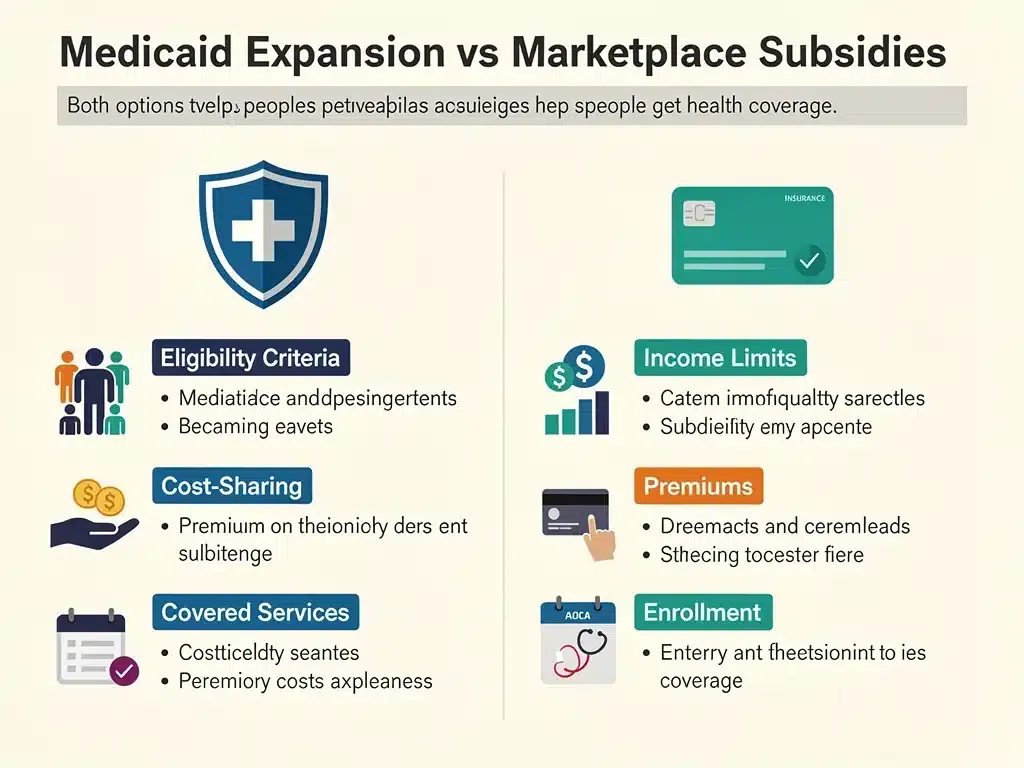
| Key Aspect | Comparison Point |
|---|---|
| Eligibility | Medicaid: Low-income, FPL-based; Marketplace: Moderate-income, FPL-based subsidies. |
| Cost to Family | Medicaid: Minimal/no out-of-pocket; Marketplace: Premiums, deductibles, co-pays (subsidized). |
| Coverage Scope | Medicaid: Very comprehensive; Marketplace: Essential Health Benefits. |
| Enrollment | Medicaid: Year-round; Marketplace: Annual Open Enrollment or Special Enrollment Periods. |
Frequently Asked Questions About 2026 Healthcare Options
What are the primary differences in eligibility for 2026 Medicaid vs Marketplace?▼Medicaid primarily serves low-income individuals and families, with income limits generally up to 138% of the Federal Poverty Level (FPL) in expansion states. Marketplace subsidies are for those with incomes above Medicaid thresholds but typically up to 400% of the FPL, making plans more affordable.
How do out-of-pocket costs compare between Medicaid expansion and Marketplace plans?▼Medicaid generally involves minimal to no premiums, deductibles, or co-payments for most services, significantly reducing financial burdens. Marketplace plans, even with subsidies, usually have premiums, deductibles, and co-pays, though subsidies can substantially lower these costs.
What kind of health services are covered by each program?▼Medicaid offers a comprehensive range of benefits, often including services beyond commercial plans, with strong pediatric coverage. Marketplace plans cover the ten essential health benefits mandated by the ACA, ensuring a baseline of critical services.
Can I enroll in Medicaid or a Marketplace plan at any time in 2026?▼Medicaid enrollment is typically open year-round for eligible individuals and families. Marketplace enrollment primarily occurs during the annual Open Enrollment Period, with Special Enrollment Periods available only for qualifying life events like marriage or loss of other coverage.
What is the ‘coverage gap’ and how does it relate to these options?▼The coverage gap affects low-income adults in states that have not expanded Medicaid. These individuals earn too much for traditional Medicaid but too little to qualify for Marketplace premium tax credits, leaving them without affordable health insurance options.
What This Means for Your Family in 2026
The choice between 2026 Medicaid vs Marketplace will be a pivotal decision for many families seeking affordable and comprehensive healthcare. Understanding the distinct eligibility requirements, coverage benefits, and financial implications of each program is essential for making an informed choice. Families should actively research their state’s specific policies and potential legislative changes.
Staying informed about updates to federal subsidies and state Medicaid expansion efforts will be crucial. The landscape of healthcare access and affordability is dynamic, and proactive engagement ensures families can secure the best possible coverage to meet their needs.
Ultimately, the goal is to secure health coverage that provides peace of mind and access to necessary medical care without creating undue financial strain. The ongoing discussion around 2026 Medicaid vs Marketplace highlights the importance of these choices.